

By using our website, you agree to the use of cookies as described in our Cookie Policy
Structural Roof Truss Needs for Multi-Story Buildings in Dallas-Fort Worth
Multi-story construction in Dallas-Fort Worth doesn't leave room for guesswork. The roof truss system you choose will either hold up under real-world conditions or become a liability before the building hits its fifth year. DFW's climate swings hard—scorching summers, ice events that shut down highways, hailstorms that shred roofs, and wind gusts that test every connection point. Add in the region's aggressive growth and evolving code requirements, and you've got a scenario where truss design isn't just structural—it's strategic.
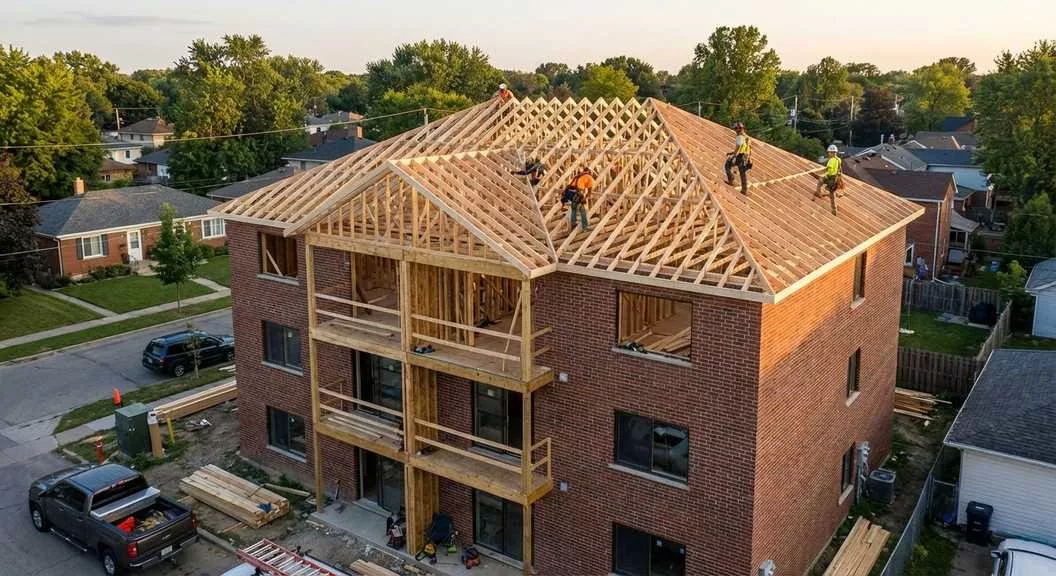
We've seen developers cut corners on truss specs to save a few thousand upfront, only to spend ten times that fixing failures down the line. The right truss system isn't the cheapest one. It's the one engineered for the loads, the weather, and the long-term performance your building demands. If you're building vertical in DFW, your truss decisions need to reflect what's actually happening on site—not what worked in another market.
Why DFW Weather Beats Up Roof Systems
This region doesn't do mild. Summer heat pushes past 100 degrees for weeks at a time, expanding materials and stressing connections. Then winter rolls in with ice storms that load roofs with weight they weren't designed to carry. Hail comes through fast and hits hard, and tornado season reminds everyone that uplift forces are real. Your truss system has to handle all of it without buckling, shifting, or losing integrity.
Most failures we see trace back to underestimating wind loads or ignoring thermal movement. When trusses aren't designed for the full range of conditions DFW throws at them, you get cracked welds, loose fasteners, and deflection that compromises the entire roof assembly. It's not about surviving one storm—it's about holding up through decades of exposure.
- Wind uplift resistance must account for tornado-prone zones and open terrain exposure
- Thermal expansion joints prevent material stress during temperature swings
- Hail impact ratings should match the region's severe weather history
- Drainage capacity needs to handle sudden, heavy rainfall without ponding
Code Compliance Isn't Negotiable
Dallas-Fort Worth operates under the International Building Code with local amendments that tighten requirements for wind, seismic, and fire resistance. Multi-story buildings face stricter scrutiny than low-rise construction, and truss systems must meet every specification. That means stamped engineering drawings, load calculations, and documentation that proves compliance before the first truss goes up.
Inspectors in this market know what to look for. If your truss design doesn't match the approved plans or if connections don't meet code, you're looking at stop-work orders and costly rework. We've worked with builders who thought they could slide by with generic truss packages—none of them got past the first inspection. Code compliance starts at the design phase, not during installation.
- IBC wind load tables must reflect DFW's exposure categories
- Fire-resistance ratings are mandatory for multi-family and commercial projects
- Seismic design requirements apply even in lower-risk zones
- Truss spacing and bearing details must align with structural plans
Steel Versus Wood for Vertical Builds
Material choice comes down to span requirements, fire ratings, and budget realities. Steel trusses dominate multi-story projects in DFW because they handle longer spans without intermediate supports, resist fire better, and don't warp or shrink like wood. For taller buildings or those with open floor plans, steel is often the only viable option. But engineered wood trusses still have a place in mid-rise construction where spans are manageable and fire protection can be added through coatings or barriers.
Steel costs more upfront but delivers better long-term performance in high-stress applications. Wood trusses are lighter and faster to install, but they require more maintenance and careful moisture management. In DFW's humidity and temperature extremes, untreated wood can degrade faster than expected. Most commercial developers default to steel for anything over three stories—it's the safer bet when liability and longevity matter.
- Steel trusses provide superior strength-to-weight ratios for long spans
- Engineered wood works well for mid-rise residential when properly treated
- Fire-retardant coatings add cost but extend wood truss viability
- Steel resists moisture damage and pest issues that plague wood systems
Span and Load Calculations That Actually Work
Multi-story buildings need open interiors—nobody wants columns cutting through office space or apartment units. That means trusses have to span farther and carry more load than typical residential systems. Dead loads include the roof assembly, insulation, and any permanent equipment. Live loads cover maintenance access, snow (rare but not impossible), and future modifications like rooftop decks or solar arrays.
Underestimating loads is one of the fastest ways to end up with a failing roof. We've seen trusses sag under HVAC units that weren't accounted for in the original design, and we've seen deflection issues from rooftop amenities added after construction. Every pound matters when you're spanning 40 feet or more. Load calculations should include worst-case scenarios, not just typical conditions.
- Dead loads must account for all permanent roof components and equipment
- Live loads should include maintenance access and potential future additions
- Deflection limits prevent damage to finishes and mechanical systems
- Long-span trusses require precise engineering to avoid mid-span sag
Fire Ratings and Acoustic Performance
Fire safety drives truss design in multi-story construction. Local codes mandate specific fire-resistance ratings based on building height, occupancy type, and proximity to property lines. Steel trusses often need fireproofing coatings or spray-applied insulation to meet these ratings. Wood trusses require fire-retardant treatment or gypsum barriers. Either way, fire protection adds cost and complexity that can't be ignored.
Sound control matters too, especially in multi-family and mixed-use buildings. Truss systems that don't accommodate sound-dampening materials lead to noise complaints and tenant turnover. Proper design includes space for insulation, resilient channels, and decoupling techniques that prevent sound transmission between floors. It's not just about meeting code—it's about delivering a building people actually want to live or work in.
MEP Coordination Prevents Costly Conflicts
Roof trusses don't exist in isolation. They share space with ductwork, piping, electrical conduit, and rooftop equipment. Poor coordination between structural and MEP teams leads to field conflicts, last-minute modifications, and delays that blow budgets. Trusses should be designed with adequate clearance for all systems, and penetrations should be planned before fabrication—not cut on site.
Rooftop HVAC units, solar panels, and communication equipment all impose point loads that trusses must support. These loads need to be identified early and incorporated into the truss design. We've seen projects where rooftop equipment was added as an afterthought, forcing expensive reinforcement work that could have been avoided with upfront planning. Coordination isn't optional—it's essential.
Trusses Built for What's Coming Next
DFW's construction market keeps pushing toward higher performance and sustainability. Roof truss systems now support cool roofs, green roofs, and solar arrays that weren't standard a decade ago. Energy codes keep tightening, and buildings that don't meet efficiency targets lose value fast. Trusses designed with future upgrades in mind give owners flexibility without requiring structural overhauls.
The truss system you install today will either support tomorrow's technology or limit it. We help builders in Dallas-Fort Worth think beyond the initial build and design trusses that accommodate evolving needs. That means extra capacity for solar loads, space for advanced insulation systems, and connections that allow for future modifications. Smart roof truss design isn't just about meeting today's requirements—it's about staying relevant as the market shifts.
Let’s Build Your Project Right from the Start
When it comes to multi-story construction in Dallas-Fort Worth, there’s no substitute for experience and precision. We’re ready to help you navigate every challenge, from code compliance to weatherproof truss design, so your building stands strong for decades. Let’s talk about your project and make sure you get the right truss system for your needs. Call us at 407-431-4263 or get a quote to get started with a team that knows DFW inside and out.
‹ Back
Recent Posts
-
Roof Truss Layouts for Custom Homes in Austin
October 1, 2026
-
Are Roof Trusses in Houston Good for Modern Home Designs?
September 17, 2026
-
-
-